Mitr Phol Group Sustainability

Edit Template

Key Stakeholders: Shareholders, Employees, Suppliers, Customers and Consumers, Communities,
Government and Civil Society Sectors

Mitr Phol is committed to sustainable energy management through energy conservation, continuous efficiency improvement, and the adoption of advanced technologies to optimize energy use and achieve its long-term energy reduction targets. The Company also strengthens employee awareness and capabilities through training and engagement initiatives, empowering employees to contribute to its energy and environmental goals. In addition, Mitr Phol collaborates with business partners to promote responsible and sustainable practices across its supply chain.

2025 Target and Performance

Indicators
Target
Performance
Energy consumption reduction compared to the baseline year 2022.
Achieve an annual energy consumption reduction of
4%.
Energy consumption increased by
11.2%* from the baseline
*Total energy consumption increased as a result of business expansion.

Management Approach

Mitr Phol has established a comprehensive energy management policy supported by systematic implementation plans covering implementation, monitoring, inspection, and performance evaluation processes. The Company also fosters employee awareness and understanding of effective energy management and conservation practices at all levels. To ensure effective implementation, each factory has established an energy management working group with the following roles and responsibilities:

  1. Develop energy management approaches aligned with the Company's energy conservation policy and identify opportunities to improve overall energy efficiency performance.
  2. Present energy management approaches to executives and relevant stakeholders to support target setting and the development of action plans.
  3. Provide training to raise awareness of energy conservation and encourage employee participation in energy management and conservation initiatives across the organization.
  4. Monitor, inspect, and evaluate the implementation of energy management practices to ensure effectiveness and alignment with organizational targets.
  5. Regularly review and communicate energy management performance to employees.
  6. Support management engagement and ensure compliance with the Energy Conservation Promotion Act B.E. 2550 (2007), as well as other applicable laws, regulations, and standards.

Energy Conservation Projects and Promotion of Renewable Energy Consumption

Mitr Phol remains committed to reducing energy consumption and continuously improving energy efficiency across its operations. Beyond achieving energy savings, many of the Company's initiatives also enhance operational efficiency. In 2025, Mitr Phol implemented a range of energy conservation and energy efficiency initiatives to support these objectives. Further information on the Company's energy management initiatives is available in the Mitr Phol Sustainability Report 2025

Promotion of Renewable Energy Consumption

In addition, Mitr Phol promotes the use of renewable energy, including solar power and biomass-based electricity generated from agricultural residues such as bagasse, sugarcane leaves, and oil palm empty fruit bunches. The Company promotes fresh sugarcane harvesting and procures sugarcane leaves and other agricultural residues from local farmers for energy generation. These efforts help reduce agricultural waste, decrease reliance on fossil fuels, and lower greenhouse gas emissions and PM2.5 air pollution, thereby contributing to climate change mitigation and improved local air quality.

In 2025, Mitr Phol relied on renewable energy

for

percent of its total energy consumption,
50

equivalent to 20.63 million megawatt-hours (MWh).
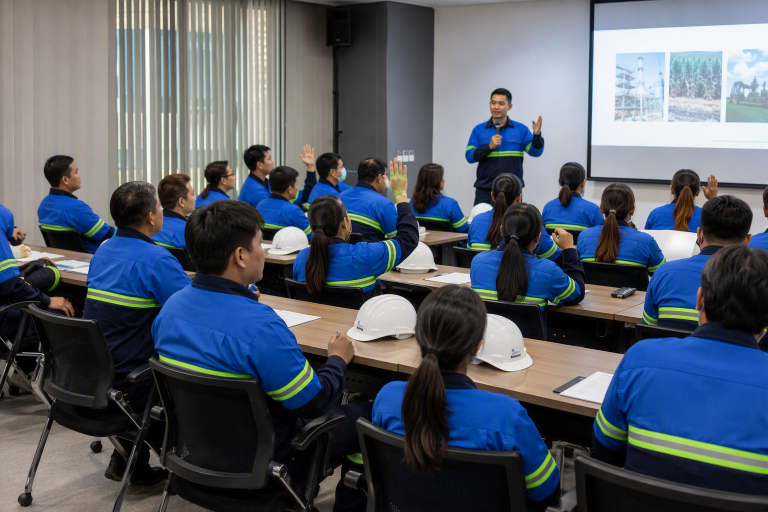
Raising Awareness on Energy Conservation

Mitr Phol Group's factories conduct energy conservation training programs tailored to the operational context of each facility. The training covers the following topics:

  • Energy conservation awareness
  • Energy-saving practices
  • Workplace electrical safety
  • The Company's energy conservation policy
  • Factory and office energy-saving measures

In addition, the Group regularly communicates its energy management policies, action plans, activities, and performance throughout the organization to encourage employee participation and foster a culture of energy efficiency and sustainable energy use.

Investments in Research and Development to Reduce Energy Consumption

In 2025, the Company piloted advanced technologies and modern equipment to improve energy and resource efficiency across its production processes. These initiatives focused on process optimization and operational improvement to enhance efficiency while reducing long-term energy impacts. Examples include:
  • Implementation of Near-Infrared Spectroscopy (NIR) technology to improve sugar production efficiency and reduce energy consumption: By enabling real-time monitoring and analysis of extraction process data, the technology allows production parameters to be adjusted accurately and continuously to meet target levels, resulting in improved process efficiency and lower energy consumption.
  • Pilot testing of fuel moisture reduction system at biomass power plants: The Company piloted a prototype system to reduce the moisture content of bagasse prior to its use as biomass fuel for electricity generation. This initiative aimed to improve fuel efficiency and minimize thermal energy losses during the combustion process.