Mitr Phol Group Sustainability

Edit Template

Key Stakeholders: Shareholders, Farmers, Employees, Suppliers, Customers and Consumers 

Mitr Phol recognizes that food loss and waste represent both an economic inefficiency and an environmental challenge, as valuable resources, including raw materials, labor, energy, and water, are consumed without generating value. Food loss and waste can also reduce food availability for vulnerable groups and contribute to methane emissions, a potent greenhouse gas. Across the sugar value chain, from sugarcane cultivation and processing to distribution and end consumption, losses may occur at various stages. Mitr Phol therefore implements measures to minimize food loss and waste, improve resource efficiency, reduce operational costs, and enhance overall operational performance.

2025 Target and Performance

Indicators
Target
Performance
The ratio of total food loss and waste to the total amount of sugar sold.
0.19 tons/ton of sugar sold
0.23 tons/ton of sugar sold

Management Approach

Sugar loss can occur at any stage of the sugar production process. Mitr Phol is therefore committed to effectively managing and reducing food loss and waste throughout its operations. The Company has established a Food Loss and Waste Policy that defines requirements for the measurement and collection of food loss and waste data, with a particular focus on sugar losses in accordance with the requirements of the Office of the Cane and Sugar Board (OCSB). Direct weighing is used as the primary measurement method, while mass balance calculations are applied to minor data streams. This approach enables the Company to analyze loss points and develop preventive measures across the supply chain. Food loss and waste data is independently verified in accordance with FSSC 22000 requirements. In addition, relevant training is regularly provided to employees across operational units to promote efficient resource use and support sustainable production and consumption. The Company's approaches to reducing food loss and waste are outlined below.

Reduction of Sugar Loss Before Crushing

  • Selecting high-quality sugarcane varieties that are suited to local climate and resistance to diseases and pests. Proper care during the growth phase, including appropriate irrigation and fertilization and weed control, promotes healthy sugarcane leading to greater sugar accumulation and reduced sugar loss before crushing.
  • Collaborative projects with partners to harvest sugarcane at the optimal time, when fully ripe, to maximize Commercial Cane Sugar (C.C.S.) quality and yield. This includes supporting sugarcane harvesters and promoting green harvesting practices through the “Let’s Green the Sugarcane” campaign, with proactive farmer engagement through accessible communication channels such as social media, signage, stickers, and banners.
  • The "From Cut to Crush" sugarcane logistics management approach uses technology to streamline queue coordination between farmers and sugarcane transporters. This helps minimise losses in cane sweetness and prevents unnecessary sugar degradation. The process controls the time from harvesting to mill delivery, targeted at no more than 8 hours through GPS tracking, efficient route planning, and reduced waiting time at the mill. As a result, farmers benefit from improved sugarcane quality and better prices.

Reduction of Sugar Loss During Sugarcane Crushing
and Production Processes

The Company has developed a sugar loss database in compliance with the regulations of the Office of the Cane and Sugar Board. This database tracks sugar loss associated with bagasse, filter cake, molasses, and unidentified causes. Data is monitored in real-time via a dashboard, enabling ongoing analysis and continuous improvement of production planning to enhance operational efficiency.
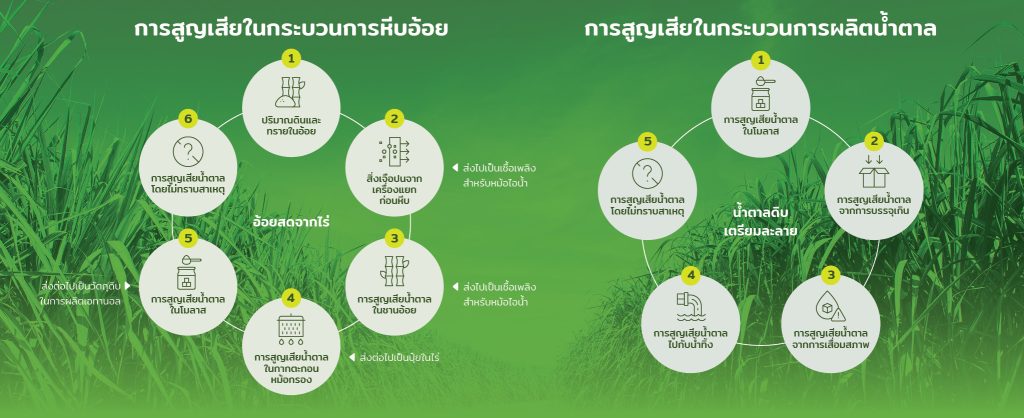
Sugar Loss During Sugarcane Crushing and Sugar Production

Reduction of Sugar Loss During Transportation

Poor packaging and inefficient transportation can contribute to sugar losses and affect product quality. Mitr Phol therefore implements effective packaging and transportation management measures throughout its operations to minimize losses and maintain product quality.

Reprocessing and Alternative Use of Substandard
and Residual Sugar and Syrup

  • The Energy Power Plant Supporting Fasting in Ramadan
    The Company provides syrup, sugar, sugarcane juice, and dates to Muslim communities near its power plants in Songkhla, Narathiwat, Yala, and Pattani provinces during Ramadan to support religious observances and strengthen community relationships. The initiative also helps prevent food loss and waste by maximizing the utilization of sugar and syrup nearing the end of their shelf life. This approach supports efficient product management while reducing the risk of food waste.
  • Recovery and Reuse of Residual Sugar and Syrup
    During the transportation of sugar and syrup to customers using tank trucks, small quantities of product may remain in the tanks after unloading. Residual sugar is recovered using compressed air, while residual syrup is drained from the tanks. These residual products are subsequently recycled and reused in the production process, helping to minimize product losses and prevent food waste. The Company also has agreements with customers to adjust transaction values to account for any residual sugar or syrup remaining in the tanks.
  • Production of Fermented Bio-Extract from Degraded Sugar
    Mitr Phu Viang Sugar Mill has implemented a fermented bio-extract production project using degraded sugar, vegetables, and fruits in collaboration with the Ban Nong Paen Hygienic Vegetable Group in Khon Kaen Province. The bio-extract is applied in agricultural plots to improve soil structure, enhance water retention, promote soil microbial activity, and support plant growth. The initiative contributes to food loss reduction by creating value from degraded sugar through beneficial reuse.

Related Policy and Statements

Food Loss and Food Waste Policy